Why does neural network pruning preserve multiple-choice and fixed-target scores, yet trigger catastrophic collapse in autoregressive generation? We provide a rigorous representation-space framework across hidden states ($h$), logits ($z$), and probabilities ($p$).
Unveiling the fundamental mechanisms that separate non-generative benchmark robustness from autoregressive decoding instability.
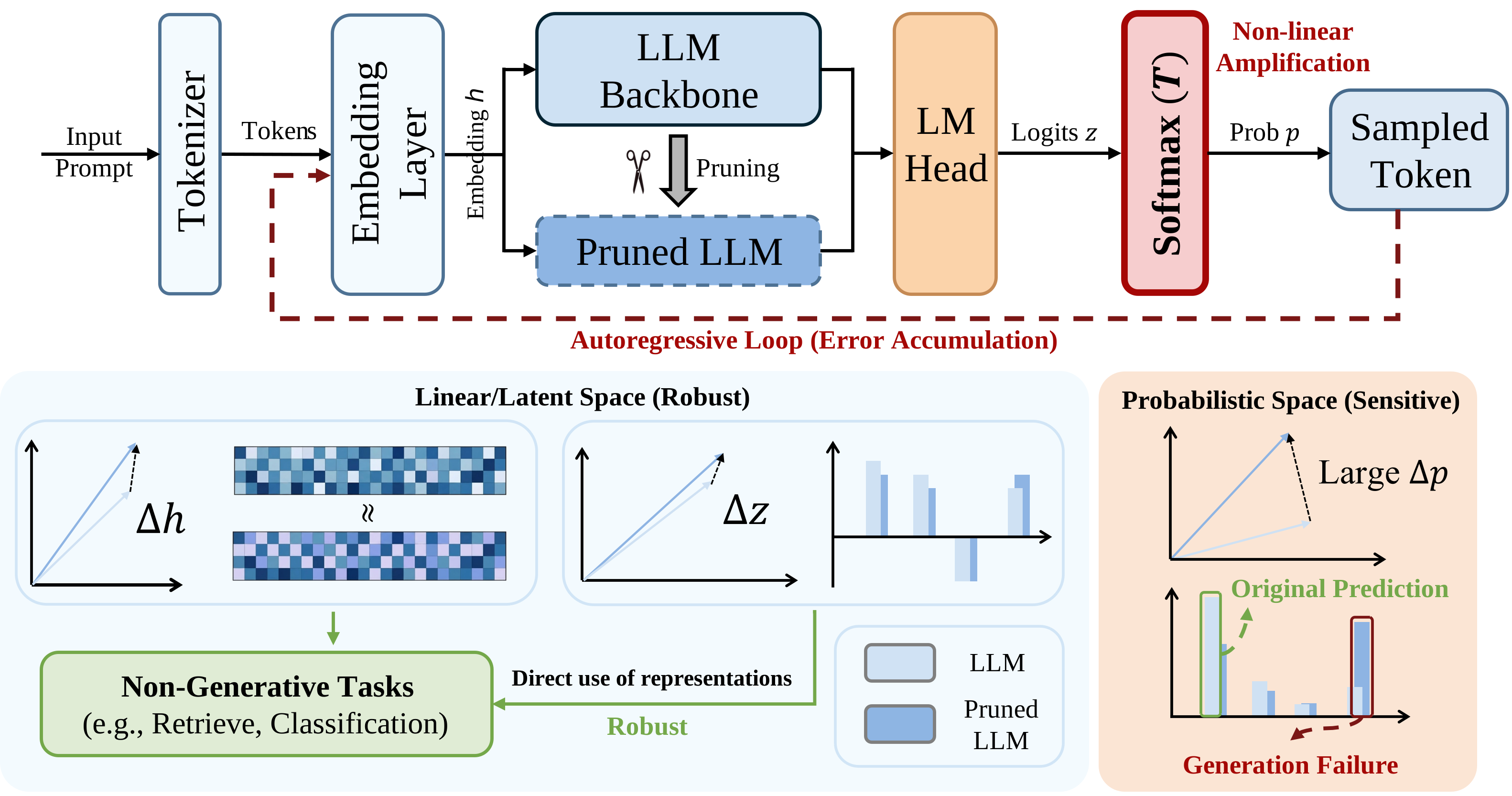
Hidden state embeddings ($h \in \mathbb{R}^d$) capture semantic direction, logits ($z = Wh$) determine candidate score margins, and probabilities ($p = \text{softmax}(z/T)$) drive the final multinomial sampling.
Decomposing perturbation into parallel scaling ($\Delta h_\parallel$) and orthogonal rotation ($\Delta h_\perp$) proves that parallel scaling merely rescales confidence, whereas orthogonal rotation rotates candidate rankings.
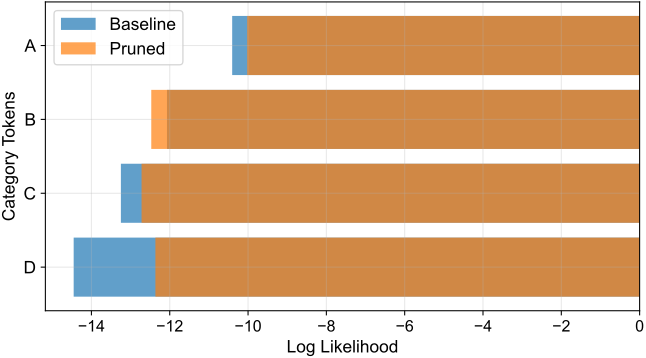
Answer-option subspaces in MCQ tasks ($\{A,B,C,D\}$) remain structurally separated under pruning. In contrast, multi-step autoregressive generation accumulates probability drift, cascading into trajectory collapse.
Inspect layer-by-layer representation alignment, orthogonal perturbations ($\Delta h_\perp$), and token-probability shifts ($p$) across modern LLM architectures.
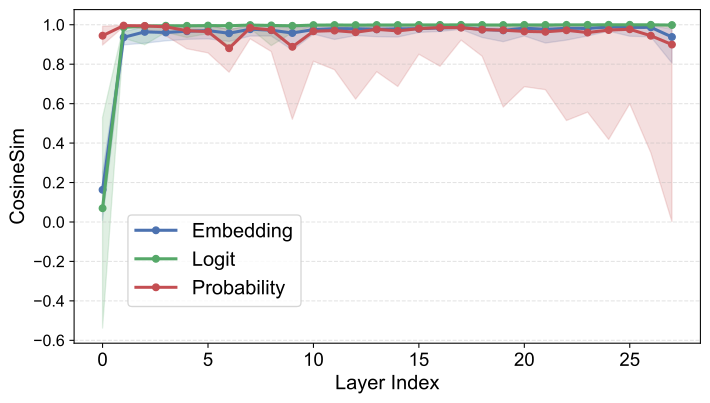
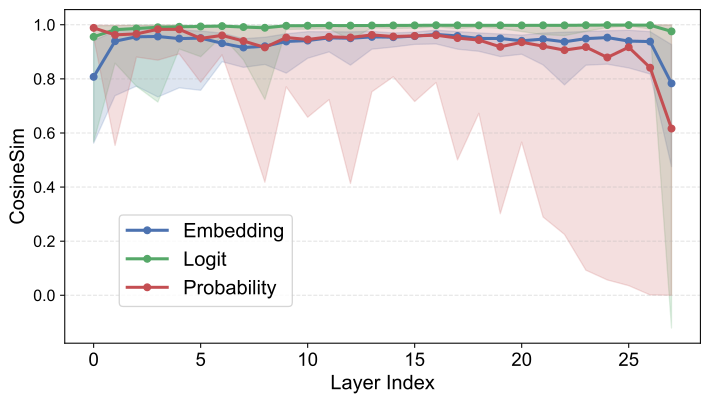
Cross-layer cosine similarity heatmap across 32 transformer layers.
Toggle interactive dynamic curves comparing representation degradation across depth, sparsity thresholds, and multi-step autoregressive decoding.
Explore the mechanistic phenomena that explain why representation hierarchies resolve the pruning paradox.
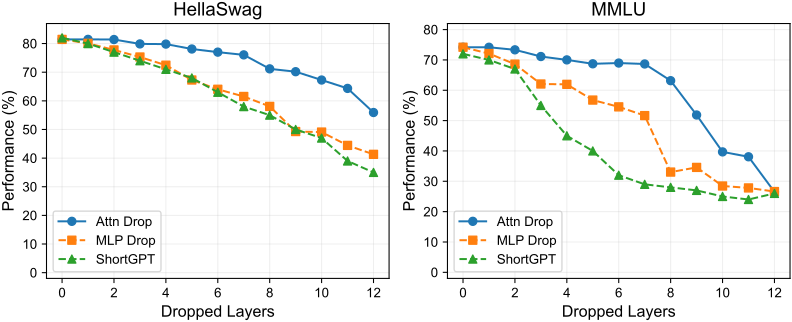
In single-step evaluations (MMLU, ARC, fixed GSM8K), models evaluate relative score differences over fixed context. Because the answer-option subspace preserves relative ranking, accuracy remains high even when large portions of weights or layers are removed.
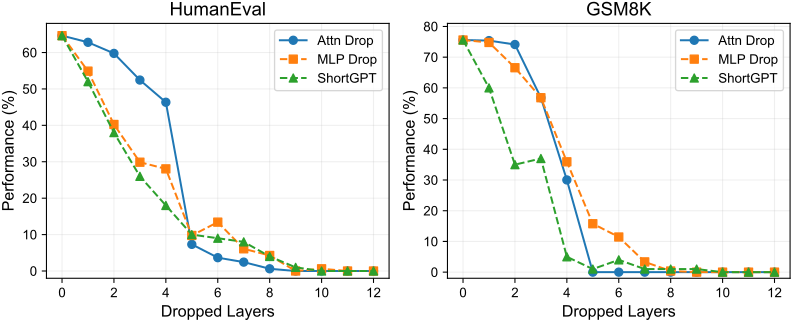
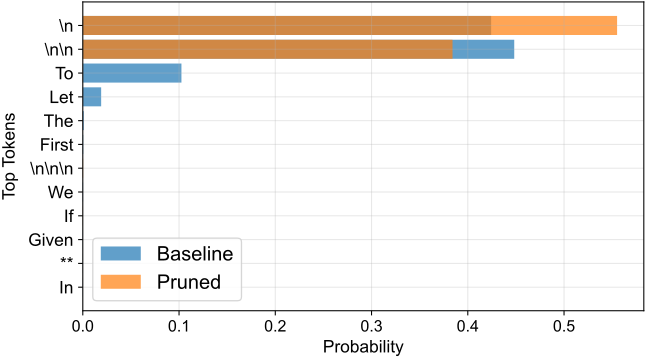
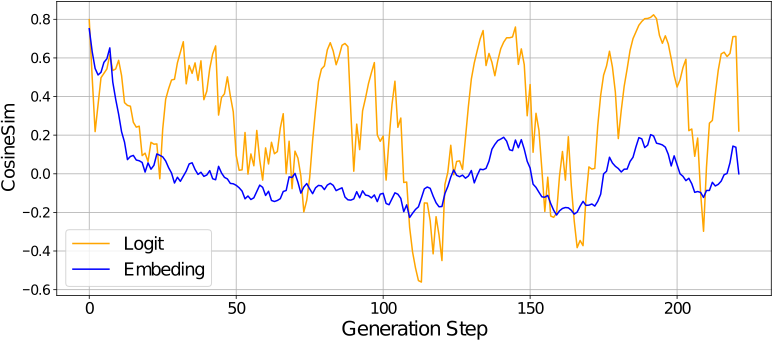
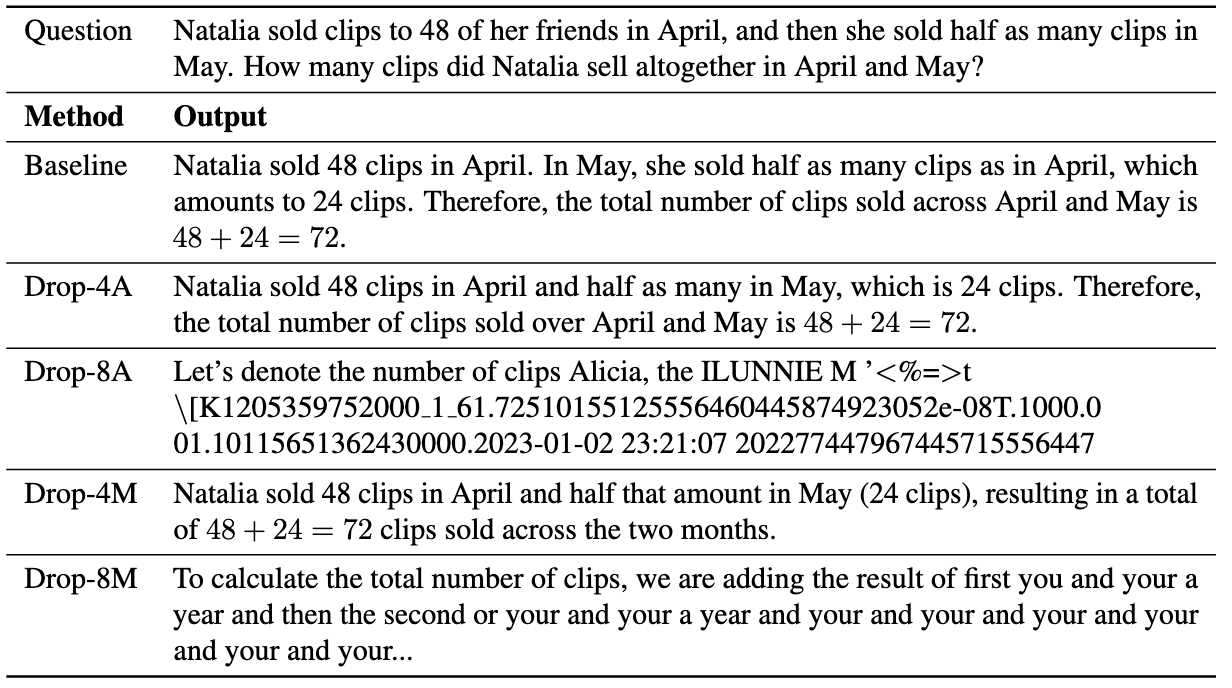
In multi-step autoregressive generation (MT-Bench, AlpacaEval, HumanEval), every token chosen feeds back into the prompt for the next step. Minor probability shifts cause token substitutions that rapidly steer generation into catastrophic drift or collapse.
Attention sublayers exhibit sharp, localized sensitivity to pruning in early-to-middle layers. Perturbations in query-key routing propagate dramatically into downstream probability entropy.
In contrast to Attention, MLP sublayers maintain smoother, more gradual degradation profiles across layers, acting as feature transformers rather than routing hubs.
Restricting logits to the multiple-choice option subspace $\{A, B, C, D\}$ shields predictions from global vocabulary-level noise, directly explaining the survival of non-generative benchmark scores.
Across the 32k-150k global vocabulary, probability mass leaks into tail tokens, dramatically increasing perplexity and triggering token substitutions in open generation.
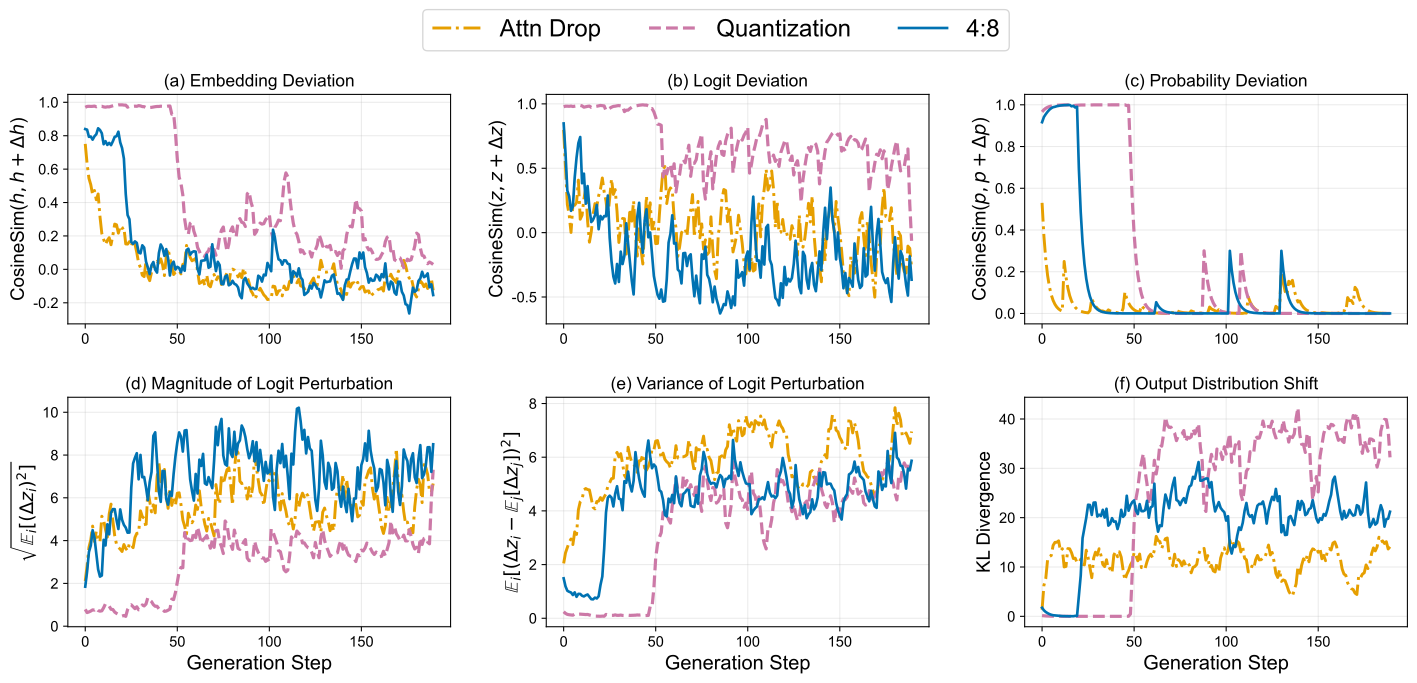
Quantization (INT8/INT4) introduces bounded, isotropic perturbations that preserve directional cosine similarity much more effectively than zeroing out weight matrices via structured or unstructured pruning.
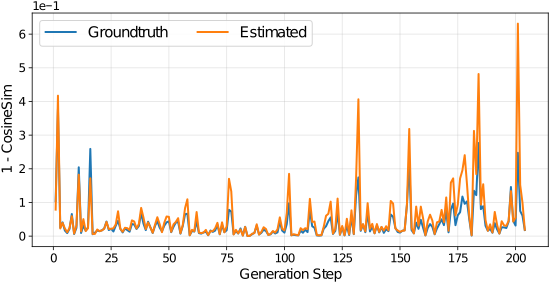
Empirical validation of Theorem 1 and Theorem 2 showing how embedding-space cosine deviations translate near-linearly into unnormalized logit-space cosine deviations.
Under layer dropping or high-sparsity pruning, the model can enter repetitive attractor loops or produce degenerate sequences during open-ended generation, even when its MMLU score remains above 70%.
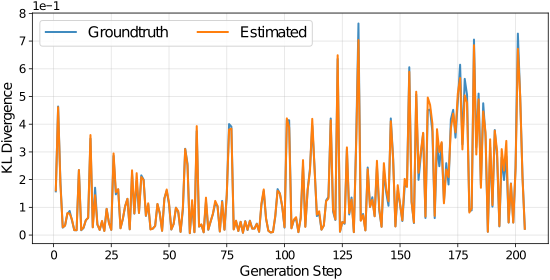
Rigorous 2nd-order Taylor expansions linking hidden states, logit variances, and probability KL divergences.
For any representation vector $x$, the cosine deviation induced by pruning is strictly governed by the ratio of orthogonal perturbation magnitude:
"Parallel perturbations rescale representation magnitude without altering angular direction; orthogonal perturbations rotate candidate rankings."
Probability-space cosine deviation expressed in terms of logit perturbation $\Delta z$, scaled inversely by temperature factor $2T^2$:
"Quantifies how probability cosine sensitivity scales inversely with the square of softmax temperature ($1/T^2$)."
The KL divergence between pruned and dense probability distributions is approximated in closed form by the $p$-weighted variance of logit shifts:
"Provides an analytical upper bound for multi-token autoregressive generation error accumulation."
Comprehensive comparison across representation preservation metrics and downstream performance.
| Model | Method / Sparsity | $\cos(h) \uparrow$ | $\cos(z) \uparrow$ | $\cos(p) \uparrow$ | $\text{KL}(p' \parallel p) \downarrow$ | MMLU $\uparrow$ | GSM8K $\uparrow$ | WikiText PPL $\downarrow$ | MT-Bench $\uparrow$ |
|---|---|---|---|---|---|---|---|---|---|
| Qwen-2.5-7B | Dense (Unpruned) | 1.000 | 1.000 | 1.000 | 0.000 | 74.2% | 81.6% | 5.82 | 8.14 |
| Block Drop (25%) | 0.962 | 0.948 | 0.892 | 0.241 | 71.8% | 76.4% | 7.94 | 6.85 | |
| Wanda (50% Unstruct) | 0.941 | 0.923 | 0.854 | 0.385 | 69.4% | 72.1% | 9.42 | 6.12 | |
| SparseGPT (2:4 Semi) | 0.928 | 0.907 | 0.829 | 0.462 | 67.1% | 68.9% | 11.20 | 5.48 | |
| LLaMA-3-8B | Dense (Unpruned) | 1.000 | 1.000 | 1.000 | 0.000 | 66.8% | 77.4% | 6.14 | 8.02 |
| Block Drop (25%) | 0.958 | 0.939 | 0.881 | 0.268 | 64.2% | 73.1% | 8.35 | 6.70 | |
| Wanda (50% Unstruct) | 0.935 | 0.914 | 0.842 | 0.412 | 61.9% | 67.8% | 10.15 | 5.94 | |
| SparseGPT (2:4 Semi) | 0.921 | 0.898 | 0.814 | 0.495 | 59.5% | 64.2% | 12.08 | 5.21 |
Run paper-aligned reproduction scripts in a few lines of code.
# 1. Clone repository and install dependencies
git clone https://github.com/CASE-Lab-UMD/Pruning-on-Representations.git
cd Pruning-on-Representations
# 2. Create python virtual environment
python3 -m venv venv
source venv/bin/activate
# 3. Install pinned requirements
pip install --upgrade pip
pip install -r requirements.txt
If you find this work helpful in your research, please cite:
@inproceedings{he2026demystifying,
title = {Demystifying When Pruning Works via Representation Hierarchies},
author = {He, Shuai and Sun, Guoheng and Zhang, Haichao and Fu, Yun and Li, Ang},
booktitle = {Proceedings of the 43rd International Conference on Machine Learning (ICML)},
year = {2026}
}